
Academic advisors face increasingly complicated demands while many colleges and universities manage tighter budgets and limited staff capacity.
But institutions cannot simply keep adding staff.
The question is not whether technology can replace advisors. It can’t. The better question is whether technology can help advisors make better use of the time and resources they already have.
Student Support Needs Are Growing
A recent Inside Higher Ed report highlights the tension facing higher education. A survey of 459 student-success leaders found that 60% identified budget constraints as a barrier to meeting student-success goals, while 55% cited staffing shortages.
At the same time, student-success leaders reported that financial challenges, mental health concerns, academic preparedness, and competing work and family responsibilities are affecting student retention.
The result is a difficult combination:
- More students need support.
- Advising teams have limited capacity.
- Institutions still need to improve retention and student success.
The same report found that advisor-to-student ratios at many institutions exceed 300 to 1, depending on the institution.
Advisors need to spend their time helping students, not searching through systems for the information they need.
Technology Should Reduce the Work Around Advising
EDUCAUSE’s 2026 Workforce Report describes a similar problem across higher education. Staffing shortages, rising service demands, increasingly complex work, and budget pressures are creating what EDUCAUSE calls a “cycle of reactivity.”
Academic advising is particularly vulnerable to this problem.
When an advisor has to search through multiple systems to understand a student’s academic history, determine which requirements remain, review previous advising conversations, and figure out whether the student needs intervention, the technology itself becomes part of the workload.
Good academic advising software should do the opposite.
Give Advisors the Information They Need
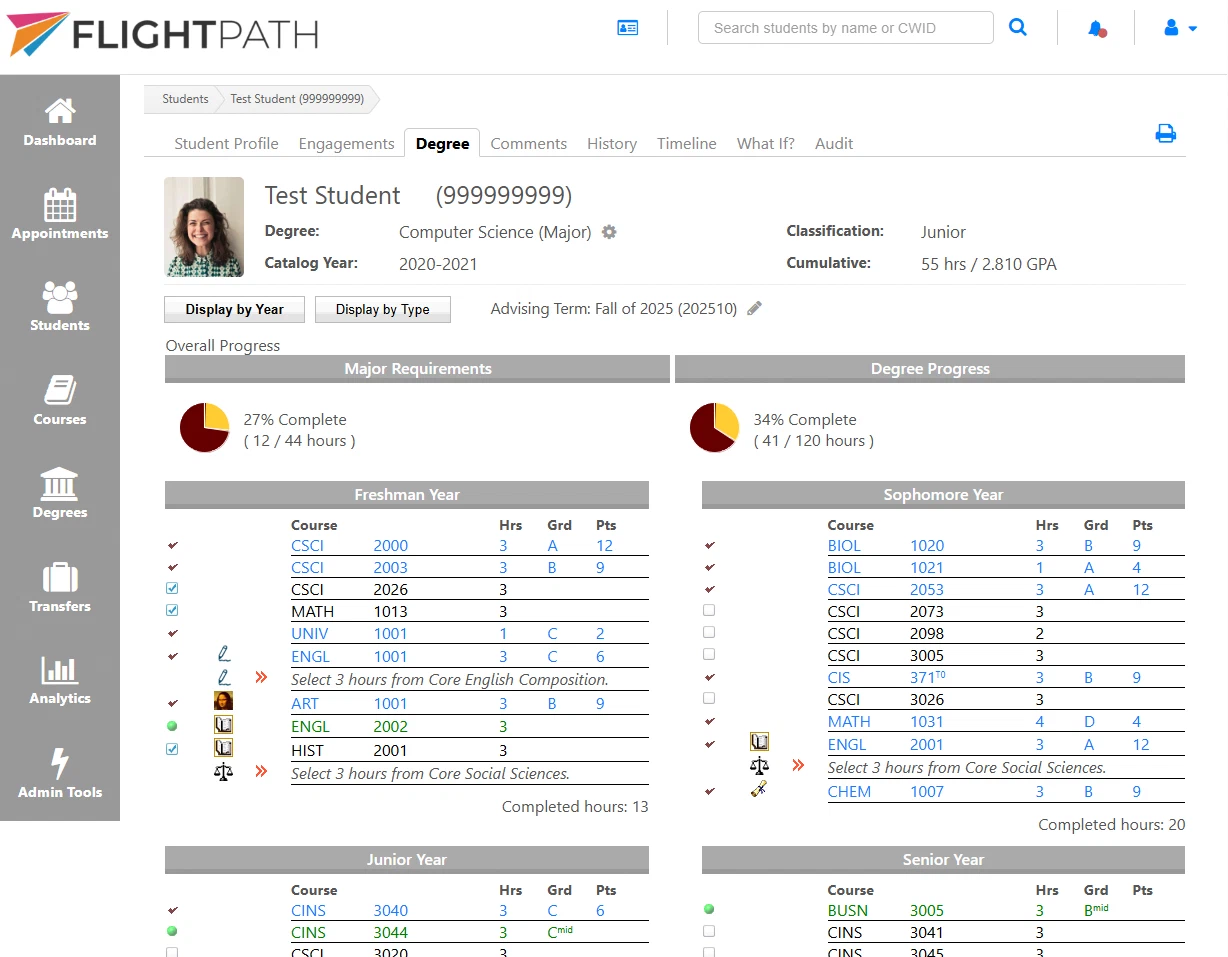
FlightPath brings academic information, advising activity, and student-success tools together in one environment.
Advisors can see:
- Academic progress and remaining degree requirements
- Planned and recommended coursework
- Advising history and notes
- Student communications and appointments
- Alerts and indicators that may require attention
That gives advisors a clearer picture of where a student is, where the student is headed, and what needs to happen next.
It also helps them spend limited advising time where it is most useful.
Make Every Advising Interaction Count
Not every student needs the same level of attention at the same time.
Inside Higher Ed found that 44% of student-success leaders identified proactive advising as one of the most effective strategies for keeping students on track. Early alerts followed closely at 43%.
When advising teams have limited capacity, proactive advising can help them focus their time on students who need additional guidance, rather than waiting for students to ask for help.
Better Technology Does Not Mean More Technology
When resources are limited, institutions need to be careful about adding systems that create more work for the people they are supposed to help.
The goal should be simple:
Give advisors useful information and useful tools in one place so they can spend more time working with students.
FlightPath brings academic advising, degree planning and degree audit, early alerts, Academic Priority, communication, appointments, reporting, and other student-success tools together in one platform.
Technology will not solve every student-success challenge. But when advisors spend less time finding information and more time helping students, limited advising capacity goes further.